Cathay Capital led the new round of financing for DeepWisdom
January 19, 2026
Asia
Are You Ready to Start Your Own Company When AI Learns to Collaborate?
Cathay Capital Leads DeepWisdom’s Investment, Creating a Golden Age for Individual Entrepreneurs.
On January 14, Cathay Capital officially announced that it led the investment in DeepWisdom (product: Atoms). The proceeds will be primarily used to further develop its multi-agent system, accelerate product-scale deployment, and expand into global markets. To date, DeepWisdom has completed both its Series A and Series A+ rounds, raising a total of US$31 million.
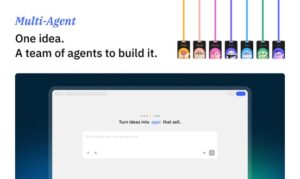
DeepWisdom is a company focused on “foundation agent technology,” with the goal of enabling AI to truly handle complex software development.
Atoms (atoms.dev), launched by DeepWisdom, isn’t designed to merely boost single-task coding productivity. Its core ambition is to let AI operate as a team—to build, ship, and continuously run real businesses end to end. By systematizing and engineering the startup-building process, Atoms materially reduces the marginal cost from idea to an operating business, giving individuals and small teams full execution power—and upgrading “Vibe Coding” into “Vibe Business.”
Atoms is not a traditional AI coding tool. It is an AI-native venture-building platform capable of running real businesses. What users orchestrate in Atoms isn’t a single model, but an autonomous team of agents—AI product managers, architects, engineers, researchers, and growth & data analysts—working together across the full business lifecycle from research and design to development, launch, and operations. This signals a redefinition of what a “company” is: entrepreneurship is no longer a privilege of capital and elites; with vision and AI, anyone can step into a new golden era of individual founders.
Wu Chenglin, Founder and CEO of DeepWisdom stated, “We’ve already validated the feasibility of multi-agent systems for complex tasks through open-source work and academic research. The real challenge, however, is enabling these systems to run reliably and sustainably over the long term in real commercial environments. What Atoms aims to do is to turn entrepreneurship itself into an engineerable, scalable system capability—so that even one person can have a complete, operating startup team.
For us, Cathay is not just an investor, but a partner that truly understands the deep transformation at the intersection of industry and technology. They share our conviction about where multi-agent systems are headed, and they’re willing to back us as we continue exploring at the convergence of research breakthroughs, product iteration, and commercial validation. That kind of support gives us greater confidence to turn the “one-person company” from an ideal into a scalable, repeatable reality.”
Cai Mingpo, Founder, Chairman and CEO of Cathay Capital said, “In the global AI wave, teams capable of simultaneously achieving scientific breakthroughs, product iteration, and business validation are extremely rare. DeepWisdom is walking its own independent and clear path with its own pace and exploration. Cathay’s value lies in helping Chinese innovation forces like DeepWisdom take the global stage and become a system solution driving global industrial upgrades.”
Introduction:
In the narrative of the AI industry, people often focus on parameters, model capabilities, or whose application is more eye-catching. But what truly determines how far a company can go is not the tool itself, but the organization behind it.
How a team absorbs knowledge, validates it through practice, and iterates its understanding through feedback determines whether it can continuously evolve.
DeepWisdom’s exploration is aimed at software-izing this “organizational capability.” It is not just answering the question of “Can AI write code?” but testing whether different agents can collaborate like a team to organize research, development, and operational processes.
From the early open-source frameworks—MetaGPT and OpenManus—to the fully commercialized Atoms, what we’re seeing is a journey from experiment to reality, and a live preview of how work and production may be redefined in the future…
From a Lonely Experiment to a Global Hit: The First Product, MetaGPT
In the wave of artificial intelligence, code generation was one of the earliest miracles to be recognized. Since ChatGPT’s release in the winter of 2022, the world was shocked for the first time by AI’s ability to “write code.” Some celebrated the soaring efficiency, while others worried that programmers would be replaced. But Wu Chenglin and his team raised a more imaginative question: What if AI is not just a coding assistant, but a “virtual team” capable of division of labor and collaboration? Could it, like a company, build a complete product and run it?
This question did not arise out of nowhere but stemmed from Wu Chenglin’s repeated verification. On November 30, 2022, just after the release of ChatGPT, he confidently stated in a discussion with several CEOs and CTOs: “Natural language programming will come soon.” A few days later, he tried to find libraries or frameworks supporting natural language programming on GitHub but found nothing.
“Code is deterministic, while natural language is probabilistic. The process of turning probability into certainty is merely a translation,” Wu Chenglin firmly believed this was the inevitable direction. However, after reviewing more than 70 open-source libraries, including the famous LangChain, he found the logic to be overly complex and not suitable for his needs. Eventually, he rolled up his sleeves and decided to write it himself.
It was a nearly solitary exploration: He created a project in PyCharm named meta_programming, which means “using programs to generate programs.”
On June 30, 2023, he launched MetaGPT on GitHub; by July, this “lonely experiment” had ranked number one on GitHub Trending 17 times. Even more unexpectedly, the open-source community spontaneously “crowdsourced” a paper (https://arxiv.org/abs/2308.00352), pushing MetaGPT’s concept to a global audience.
The core idea of MetaGPT is to assign different AI agents to different “roles”: some are responsible for market research and requirement documentation, some for system architecture, some write code, and others do testing, collaborating like an assembly line. In this way, a product development process that would typically require multiple people is abstracted into a virtual team of AIs. Its popularity is not just because it’s “fun,” but because it was the first to visually prove an avant-garde concept: AI is not just a single-point intelligence; it can be organized into teams, thus exhibiting a collective intelligence that surpasses individual capabilities.
“Choose to do the hard but right thing, and time will be on our side”
The success of MetaGPT placed the team under the global spotlight overnight, but the excitement of open-source popularity does not directly translate into sustainable commercial value.
From 2023 to 2024, during the capital winter and the emergence of LLM technology, DeepWisdom faced cash flow crises three times. To survive, the team relied on customer payments, renewals, and loans from friends and family, with wages never interrupted; core members had not had a salary increase or year-end bonuses for three years but chose to continue together.
In February 2025, MetaGPTX launched at the most capital-constrained moment for the company. Thanks to years of open-source advocacy, industry partners stepped in proactively. The result was immediate: within its first month, the product crossed a US$1 million ARR run rate, earning early and strong user validation.
Two years of difficult transformation led to a more solid starting point—this was also DeepWisdom’s first real move into the consumer market, and it went on to generate the strongest traction and largest share of attention among the wave of vibe-coding products released during the same period.
Such performance is a first in the Chinese market; globally, only competitors like Cursor and Lovable have achieved similar speed and scale. The difference is that Atoms is not a point-specific “code-writing assistant,” but an “AI team” based on a multi-agent framework capable of completing more complex tasks and exhibiting greater flexibility and completeness. This means it not only improves efficiency but also reshapes the boundaries of software development paradigms.
From Tool Application to the Future of Organizational Intelligence
Whether it’s MetaGPT’s open-source viral success or Atoms’ rapid commercialization, Cathay values not just the short-term performance of individual products but the core path that DeepWisdom is tapping into: the core logic of AI applications. Code is the most natural landing scenario for large models—it has standard answers, immediate feedback, and forms a self-reinforcing flywheel. But the deeper significance is that code is essentially the interface between humans and the digital world, yet only a few people understand it. What Atoms does is drastically lower this threshold, allowing anyone to create applications with natural language, just like short videos have enabled anyone to become a content creator. More importantly, this team is not just staying at the conceptual level; through the global influence of the open-source community and tangible cash flow growth, they have already verified the future vision of the “AI team” as a present-day reality.
The competition in AI coding is entering deeper waters. Initially, people marveled at how AI could “write faster,” helping developers complete auto-completion or fix bugs; then, tool platforms emerged, allowing users to “generate” application prototypes with one click. But the real turning point is approaching: AI is no longer a standalone assistant but begins to collaborate as a team. Different agents take on different roles, balancing and complementing each other, gradually forming a new “organizational intelligence.”
In this framework, the future becomes clearer: Humans have only 3% of their data on the internet, utilized by LLMs, while the remaining 97% exists in organizations, individuals, and the offline world. DeepWisdom is liberating this dormant productivity from the “black hole” and handing it over to every individual with ideas. Through an agent network, these originally scattered data and ideas will be transformed into real value. This is not just about improving efficiency but about redistributing and igniting productivity.
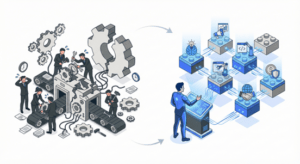
The old paradigm: Starting a company requires lengthy hiring, onboarding, communication, and management, like assembling a complex machine by hand, where every link may fail, consuming a lot of time and energy. The new paradigm: DeepWisdom introduces the “atomized entrepreneurship” model—you no longer need to build a team but can call on different expert agents like assembling LEGO pieces. You are not managing employees; you are commanding an AI army composed of super-capable agents. Entrepreneurship shifts from being resource-intensive to idea-intensive; the relationship between humans and tools evolves into a collaboration network between humans and intelligence.
Imagine a future where anyone with a unique idea can become an entrepreneur. The concept of “personal studios” will be completely rewritten: one person can run a highly efficient company, continuously creating, iterating, and growing. The future business world will no longer be monopolized by large enterprises, but will be made up of countless flexible, efficient, and creative micro-intelligent companies that can quickly respond to market demands and fill every small business gap.
More than two thousand years ago, Greek philosophers envisioned that everything we see in the magnificent universe originates from a small, indivisible particle—an atom. This idea inspires us that the greatest creations begin with the most fundamental “one.” Today, in the business world, we are witnessing a revolution at the “atomic” level. This new “atom” can be any small idea, a universal backend capability, or even an independent entrepreneurial individual. From the lonely open-source experiment of winter 2022, DeepWisdom has walked an unusual path. This is not only a company’s growth trajectory but also a microcosm of artificial intelligence evolving from a point tool to organizational intelligence. We are standing at the starting point of a new commercial civilization: an AI universe made up of countless “atoms,” where every small idea can ignite productivity, and every individual can unleash the power to change the world…